

Table of Contents
1. Cutting Principle & Movement
Turning inserts: Workpiece rotates, tool moves linearly. Continuous cutting.
Milling inserts: Tool rotates, workpiece moves. Intermittent cutting with impact.
2. Insert Structure & Shape
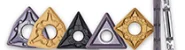
Turning inserts usually have triangular, rhombic, square, or round shapes with specific clearance angles.
Milling inserts are designed for multi-edge cutting, with stronger edge stability and impact resistance.
Zhuzhou Jinzuan provides professional turning inserts and milling inserts for different applications.
3. Application Scenarios
Turning inserts: For cylindrical parts, facing, grooving, threading, and profiling.
Milling inserts: For plane milling, side milling, slotting, contouring, and 3D machining.
4. Force Bearing & Impact Resistance
Turning inserts bear stable force with less impact.
Milling inserts bear repeated impact and shock, requiring higher toughness.
5. Grade & Coating Differences
Turning inserts focus on wear resistance and high-speed stability.
Milling inserts need better toughness, anti-fracture, and heat resistance.
6. Summary & Selection Guide
Do not mix turning and milling inserts — this will cause chipping, poor surface finish, or tool breakage.
Choose turning inserts for lathe operations and milling inserts for machining centers. Always use matching grades and holders for best performance and tool life.
Looking for Professional Turning & Milling Inserts?
Zhuzhou Jinzuan provides full series of high-performance turning inserts, milling inserts, grooving inserts, and threading inserts with stable quality and long service life.
Contact Us Now